
What Kind of Animal is an Owl? Information and Characteristics
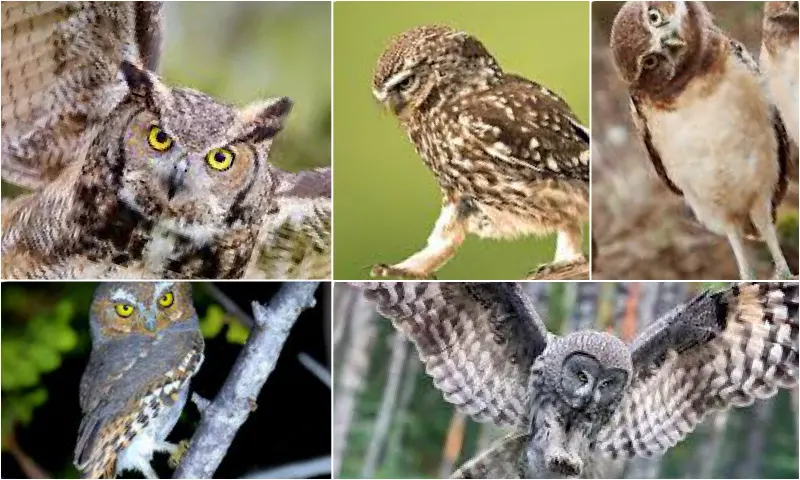
The large, rarely blinking eyelids give the owl's face a clarity of expression that most other birds lack. Undoubtedly, this expression is closely related to the wisdom attributed to owls. In reality, an owl's brain is not very busy. Its eyeballs are the size of a human's, but excluding the feathers on its head, its skull is only about the size of a golf ball. There isn't much space in this area for problem-solving. Owls look this way because they are incredibly specialized at catching their small prey in the darkness of night. Their enormous pupils can absorb a large amount of light, and their eyeballs have taken on a shape similar to salt shakers in restaurants to capture as much of the absorbed light as possible onto the retina. The retina also has sensitive, cone-shaped parts that focus on detail and are sensitive to light, allowing the owl to see even in environments where there is almost no light left. The eyes of the long-eared owl (Asio otus) are so sensitive that it can see a motionless mouse illuminated by as much light as a single candle can illuminate a football field. However, this incredibly capable eye has a drawback: the owl cannot move its eyes.
Changing its Perspective
If it wants to precisely determine the location of an object, it turns its head and looks at the object from different angles. But the eyes are only half the story. Interestingly, the owl's ears are also very sensitive. The flat feathers on its face allow the animal to capture sound like a pair of satellite dishes and direct it to its ears. The ears have enormous vertical slits on both sides of the skull that point downwards. These are sometimes tilted at the top of the head or one is higher than the other. This means the owl can adjust the opening of its ears to its needs. This allows it to detect the small, momentary movements of its prey, calculate how long it takes for the sound of a mouse's movements to reach its ears, and thus determine its exact location. They achieve sufficiently accurate results for species that hunt in complete darkness. In addition to their extraordinary vision and hearing, owls have a unique silent flight system. Their bodies and legs are covered with numerous fine feathers. Even when the feathers on their wings are open, the fringes at their tips allow air to pass through, facilitating their glide. This feature makes them appear much larger than they are.





